Executive Summary
At a Glance
National Digital Public Infrastructure (NDPI) — encompassing digital identity, real-time payments, trusted data exchange, and government cloud platforms — has emerged as one of the defining policy investments of the 2020s. Countries that build it well unlock dramatic gains in financial inclusion, fiscal efficiency, and private-sector innovation. Those that build it poorly — or fail to fund it adequately — risk deepening digital divides and ceding sovereignty to proprietary platforms.
This report examines how governments finance NDPI: the mix of budget allocations, multilateral development bank (MDB) lending, public-private partnerships, and innovative mechanisms that together constitute the funding architecture for digital public goods. Drawing on case studies from India, Estonia, Brazil, Ukraine, Nigeria, and beyond, it identifies the financing models that work — and the governance frameworks that must accompany them.
(2020–2025 est.)
to DPI via UN SDG
(India, 2025)
(2009–2019)
1. Introduction: Infrastructure for the Digital Age
Throughout the twentieth century, governments invested in physical infrastructure — roads, bridges, ports, electrical grids — as the backbone of economic development. In the twenty-first century, a parallel class of digital infrastructure has emerged, equally foundational and no less demanding of public investment.
National Digital Public Infrastructure (NDPI) refers to the shared digital systems that enable service delivery at societal scale. The G20 New Delhi Leaders' Declaration (2023) defined DPI as "a set of shared digital systems that are secure and interoperable, built on open standards, to deliver equitable access to public and/or private services at societal scale." This definition, while aspirational, captures the core ambition: digital systems that function as public goods, much as a highway or a water system does.
The financing question, however, has received far less analytical attention than the technology itself. How should governments pay for digital identity systems that may cost over a billion dollars to roll out? What is the right balance between sovereign budget allocation and concessional lending from the World Bank or regional development banks? Can public-private partnerships deliver NDPI without compromising its character as a public good?
This report addresses those questions through a comparative analysis of financing models across six country cases, an assessment of multilateral and philanthropic funding channels, and a cost-benefit framework for evaluating NDPI investments. It is intended for policymakers, development finance practitioners, and scholars of digital governance.
2. The Four Pillars of NDPI
Though the specific architecture varies by country, most NDPI frameworks converge around four functional layers. Each presents distinct financing challenges and cost structures.
2.1 Digital Identity
Population-scale digital ID systems — such as India's Aadhaar (1.38 billion enrolled), Estonia's e-ID (used by 99% of the population), and Nigeria's NIN — provide the authentication layer upon which other services depend. These are typically the most expensive single component of NDPI, requiring biometric enrolment infrastructure, secure database architecture, and ongoing authentication services.
Aadhaar's total programme budget reached approximately ₹113.66 billion (US$1.2 billion) by August 2019 — roughly $0.90 per enrolee. Estonia's e-ID system, built incrementally since 2002, cost an estimated €100–150 million over two decades — an order of magnitude less per capita, reflecting Estonia's smaller population and digital-first approach from the start.
2.2 Digital Payments Infrastructure
Real-time payment systems — India's UPI, Brazil's Pix, the EU's evolving instant payment regulation — form the transactional backbone of the digital economy. UPI, launched in 2016, now processes over 250 billion transactions annually worth US$3.4 trillion, accounting for 84% of India's digital payments. Brazil's Pix, launched in 2020, reached 150 million users within three years.
These systems are relatively inexpensive to build — UPI's development by the National Payments Corporation of India (NPCI) was funded largely through member bank contributions and transaction fees — but their success depends on the existence of a robust identity layer and widespread banking access.
2.3 Data Exchange Platforms
Secure, interoperable data exchange layers — such as Estonia's X-Road, India's DigiLocker and Account Aggregator framework, and Ukraine's Trembita — enable government agencies and, in some models, private-sector entities to share verified data with citizen consent. X-Road, open-sourced under an MIT License in 2016 and now governed by the Nordic Institute for Interoperability Solutions (NIIS), handles over 1.5 billion queries annually in Estonia alone.
Financing for data exchange layers typically flows through government IT budgets, with Estonia and Finland jointly funding NIIS at approximately €2–3 million annually — remarkably modest for infrastructure that underpins nearly all digital government services.
2.4 Government Cloud & Digital Services Platforms
The application layer — government cloud infrastructure, e-services portals like Ukraine's Diia, and digital health platforms like India's Ayushman Bharat Digital Mission (ABDM) — represents the most visible face of NDPI but is often built atop the other three pillars.
Ukraine's Diia app, developed with US$5 million in initial funding from USAID and other donors plus Ukrainian budget allocations, now serves over 20 million users with 120+ government services — a striking example of lean investment yielding transformative public benefit, even amid wartime conditions.
3. Funding Models: A Comparative Anatomy
No country finances NDPI through a single channel. The mix varies substantially by income level, institutional capacity, and political economy. Broadly, six funding sources dominate the landscape.
3.1 Government Budget Allocation
Sovereign budget expenditure remains the largest single source of NDPI funding globally, accounting for an estimated 50–70% of total investment in middle-income countries. India's model is emblematic: Aadhaar and UPI were developed almost entirely through central government allocations, with the Unique Identification Authority of India (UIDAI) and NPCI operating as government-backed entities. The key advantage is control — governments retain full architectural and policy authority. The key risk is fiscal sustainability in countries with constrained budgets.
3.2 Multilateral Development Bank (MDB) Lending
The World Bank, Asian Development Bank (ADB), African Development Bank (AfDB), Inter-American Development Bank (IDB), and European Investment Bank (EIB) have together committed an estimated $9–10 billion to digital infrastructure projects between 2020 and 2025, of which roughly $4–5 billion is specifically DPI-related. Concessional lending through the International Development Association (IDA) has been particularly important for low-income countries, where NDPI may be unaffordable through domestic resources alone.
3.3 Public-Private Partnerships (PPPs)
PPPs — where private consortia build and sometimes operate DPI components under government concession — account for an estimated 15–20% of NDPI financing. Estonia's e-Residency programme and elements of India's ONDC (Open Network for Digital Commerce) follow variants of this model. The attraction is access to private capital and technical expertise; the risk is lock-in and the potential erosion of public-good character.
3.4 Philanthropic & Bilateral Aid
The Bill & Melinda Gates Foundation, the German Sovereign Tech Fund, USAID, GIZ, and other bilateral and philanthropic actors have provided crucial catalytic funding — particularly for open-source DPI components, standards development, and capacity building in low-income countries. The Gates Foundation's support for India's Account Aggregator framework and the Modular Open Source Identity Platform (MOSIP) are prominent examples. While these sums are modest relative to MDB lending (±$500 million annually across all philanthropic sources), their catalytic effect can be substantial.
3.5 User Fees & Service Levies
A minority but growing funding stream: per-transaction fees (UPI's zero-MDR model is an exception — most real-time payment systems charge merchants), identity verification charges, and data access fees for private-sector users. The challenge is calibrating fees to fund operations without undermining adoption — a tension visible in debates over UPI's long-term sustainability.
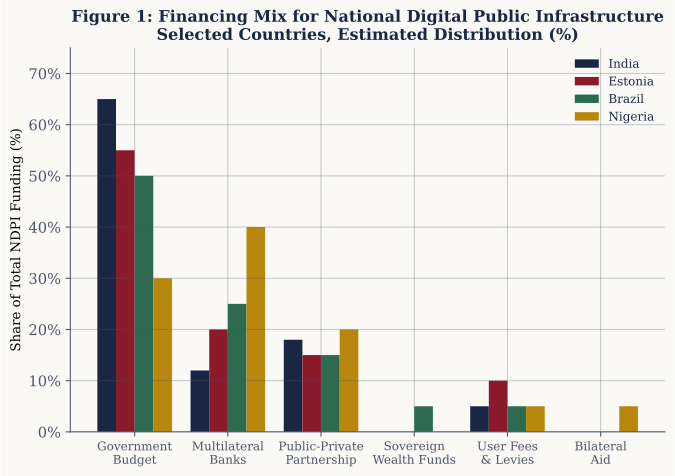
Figure 1: Estimated financing mix for NDPI in four representative countries. India relies most heavily on sovereign budget; Nigeria depends substantially on MDB concessional lending.
3.6 Comparative Investment by Country
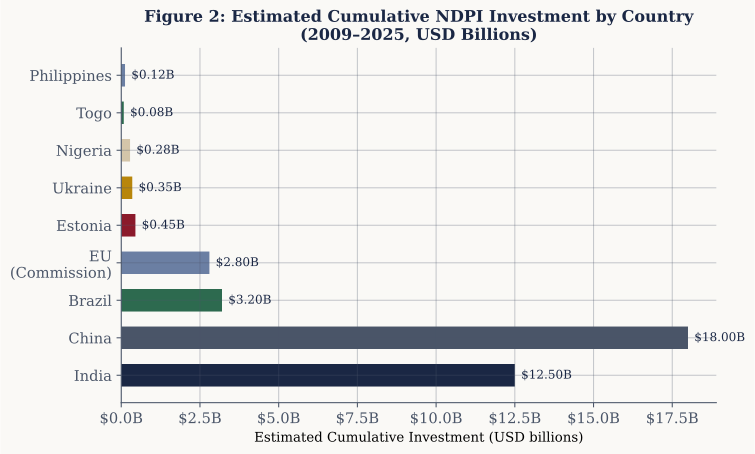
Figure 2: Estimated cumulative NDPI investment across nine countries and the EU Commission. India and China lead in absolute terms; Estonia and Ukraine demonstrate lean, high-impact models.
4. Country Case Studies
India: The Scale Play
India's India Stack — Aadhaar (identity), UPI (payments), DigiLocker (documents), and Account Aggregator (data sharing) — is the world's most ambitious DPI deployment. Total public investment exceeds $12 billion across all components, with the central government bearing ~65% of costs.
- Aadhaar: $1.2B, covering 1.38B people
- UPI: $0.5B+ development, now 250B+ annual txns
- DigiLocker: 150M+ users, government-funded
- Key insight: Sovereign budget dominance + zero-MDR policy drove mass adoption
Estonia: The Lean Pioneer
Estonia built its X-Road data exchange layer and e-ID system incrementally from 2001, spending an estimated $400–500 million across all digital government infrastructure over two decades — roughly $300 per capita.
- X-Road: Open-sourced 2016 (MIT), NIIS budget ~€2–3M/yr
- e-ID: Mandatory since 2002, 99% population coverage
- Key insight: Incremental build, open-source governance, lean budgets, cross-border (Finland) cooperation
Brazil: Pix and Gov.br
Brazil launched Pix in 2020, developed by the Central Bank at an estimated cost of $50 million. Within three years it reached 150 million users and processes 40% of all Brazilian digital transactions.
- Pix: Central Bank-funded, zero-cost for individuals
- Gov.br: 155M users, single sign-on for 4,900+ services
- Key insight: Central bank-led payment infrastructure, rapid adoption via mandatory bank participation
Ukraine: Diia and Resilience
Ukraine's Diia app, launched in 2020 with $5 million in initial funding (USAID + government budget), now serves 20M+ users with 120+ services, including digital ID, business registration, and wartime documentation.
- Diia: $5M initial, now ~$15M total investment
- Trembita: Data exchange layer based on X-Road, EU-aligned
- Key insight: Donor+state co-financing, wartime acceleration of digital adoption, EU accession-aligned standards
| Country | Primary DPI Components | Est. Investment | Dominant Funding Model | Population Coverage |
|---|---|---|---|---|
| India | Aadhaar, UPI, DigiLocker, ABDM, ONDC | $12+ billion | Sovereign budget (65%) | 1.38B (ID), 500M+ (UPI) |
| Estonia | X-Road, e-ID, e-Residency | $450 million | Sovereign budget + EU funds | 1.3M (99% pop.) |
| Brazil | Pix, Gov.br, Digital ID | $2.8 billion | Central bank + sovereign budget | 150M (Pix), 155M (Gov.br) |
| Ukraine | Diia, Trembita | $15 million | Donor + sovereign co-finance | 20M+ users |
| Nigeria | NIN, BVN, NAFDAC digital | $280 million | MDB concessional (40%) + budget | 110M (NIN) |
| Togo | Novissi (digital cash transfer) | $80 million | World Bank IDA + bilateral | 1.8M beneficiaries |
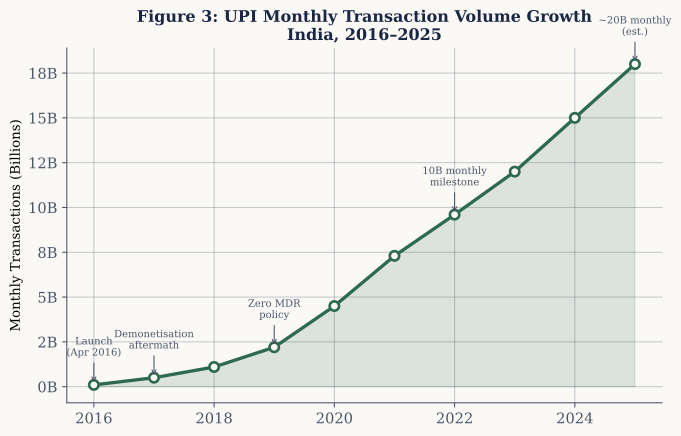
Figure 3: UPI's exponential trajectory — from 100 million monthly transactions at launch to an estimated 18 billion monthly in 2025. The zero-MDR policy from 2019 was a critical accelerant.
5. Multilateral & Development Finance Architecture
For low- and lower-middle-income countries, MDB lending is often the enabling condition for NDPI investment. The architecture, however, is fragmented — with different institutions funding different layers and little formal coordination.
5.1 The World Bank Group
The World Bank has been the single largest multilateral financier of digital infrastructure, with an estimated $4.8 billion in DPI-specific lending between 2020 and 2025. Key instruments include IDA credits (concessional, for low-income countries), IBRD loans (near-market, for middle-income countries), and the Digital Development Partnership (DDP), a multi-donor trust fund providing technical assistance. Flagship projects include Nigeria's Digital Identification for Development (ID4D) project ($430 million), Ethiopia's Digital ID project ($350 million), and the Philippines' National ID system ($600 million).
5.2 Regional Development Banks
The Asian Development Bank (ADB) has committed approximately $1.9 billion to digital infrastructure across its developing member countries, with strong emphasis on digital ID and payment interoperability in South and Southeast Asia. The African Development Bank (AfDB) has mobilized roughly $700 million, concentrated on digital ID and government digitization. The Inter-American Development Bank (IDB) committed ~$1.2 billion, with notable support for Brazil's digital transformation and the Andean region's cross-border data exchange initiatives.
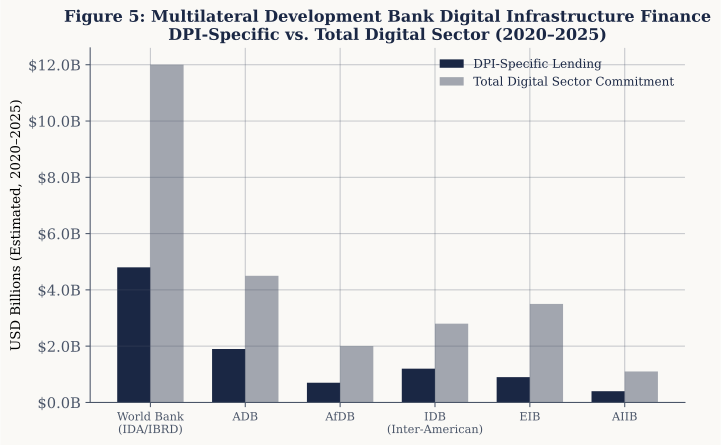
Figure 5: DPI-specific lending compared to total digital sector commitments for six major MDBs. The World Bank dominates, but regional banks play critical roles in country-specific contexts.
Key Finding
DPI-specific lending represents only 40–50% of MDBs' total digital sector commitments — the remainder goes to broadband, digital skills, cybersecurity, and sectoral digitization. This suggests room to increase DPI's share, particularly for data exchange and cloud infrastructure layers that remain underfunded relative to digital ID and payments.
6. The Economics of Public Digital Goods
6.1 Why NDPI Is a Public Good — and Why That Matters for Financing
NDPI exhibits the classic characteristics of a public good: it is non-rivalrous (one person's use of a digital ID doesn't diminish another's) and non-excludable in aspiration (systems are designed for universal coverage). This creates a textbook case for public investment — private markets will systematically underinvest in universal digital infrastructure because the full social returns cannot be captured by any single firm.
The implication for financing is clear: governments must lead, but the scale of investment required in low-income countries exceeds domestic fiscal capacity, making concessional finance essential.
6.2 Returns on Investment: What the Data Shows
While rigorous cost-benefit analyses of NDPI remain scarce, the available evidence suggests extraordinary returns:
- Subsidy leakage reduction: India's Direct Benefit Transfer (DBT) system, enabled by Aadhaar, saved the government an estimated $35 billion in reduced leakage and ghost beneficiaries between 2014 and 2021 — a return of approximately $35 per dollar invested in the Aadhaar programme.
- Tax compliance: Countries with digital ID-linked tax systems report 15–25% increases in tax-to-GDP ratios, worth multiples of the infrastructure investment.
- Financial inclusion: India's Jan Dhan-Aadhaar-Mobile (JAM) trinity brought 500 million people into the formal financial system — with downstream effects on credit access, savings, and entrepreneurship that are still unfolding.
- Government efficiency: Estonia estimates that X-Road and e-services save the equivalent of 2% of GDP annually in reduced bureaucracy and processing time — roughly €800 million per year on a digital government investment of ~€400 million over two decades.
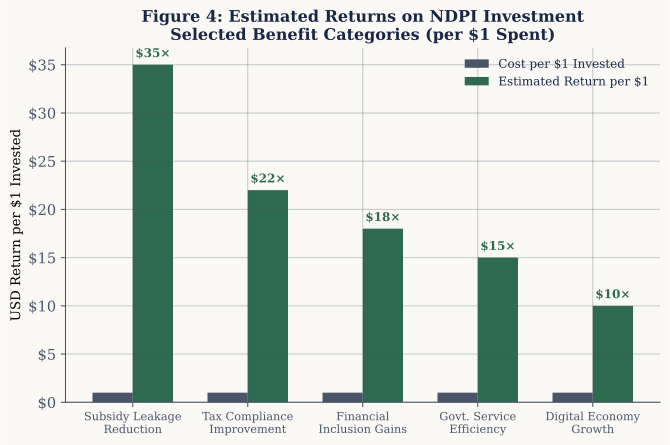
Figure 4: Estimated returns per dollar of NDPI investment across five benefit categories. Subsidy leakage reduction and tax compliance improvements offer the highest measurable returns, but financial inclusion and government efficiency gains may prove more durable over the long term.
7. Financing Risks & Governance Imperatives
Financing NDPI is necessary but not sufficient. The terms of financing — and the governance frameworks that accompany it — determine whether digital infrastructure empowers citizens or enables surveillance, fosters competition or entrenches monopolies.
7.1 The Privacy-Surveillance Tension
Large-scale digital ID and payments systems generate unprecedented concentrations of personal data — biometrics, transaction histories, location patterns, and service usage. When financed and operated solely by the state without independent oversight, these systems can become instruments of surveillance. India's Aadhaar experience — with documented cases of welfare exclusion due to biometric authentication failures, including deaths from starvation linked to denial of food rations — offers a cautionary tale. The financing model matters: systems funded through transparent budget processes with legislative oversight tend to have stronger privacy protections than those funded through opaque executive allocations or security-service budgets.
7.2 Debt Sustainability
For low-income countries, financing NDPI through MDB loans — even concessional ones — adds to already-precarious debt burdens. With over 25 IDA-eligible countries in or near debt distress, the case for grant-based DPI financing for the poorest countries is strong. The UN's identification of DPI as a high-impact SDG accelerator strengthens the argument for reallocating ODA toward digital infrastructure.
7.3 Vendor Lock-in
When NDPI is financed through PPPs or tied procurement, there is a material risk of vendor lock-in: governments become dependent on proprietary technology stacks whose costs escalate over time. Estonia's decision to open-source X-Road under an MIT license and establish a multilateral governance body (NIIS) offers a replicable model for avoiding this trap. The German Sovereign Tech Fund's approach — providing grants directly to open-source digital infrastructure maintainers — points toward an alternative financing model that preserves public-good character.
7.4 The Digital Divide
NDPI can deepen the digital divide if financing focuses exclusively on the technological backbone without complementary investment in digital literacy, device access, and last-mile connectivity. India's experience with CoWIN during the COVID-19 pandemic — where 25% of the population without smartphones were initially unable to register for vaccination — illustrates the risk. Effective financing must include the "soft infrastructure" of adoption.
8. The NDPI Financing Ecosystem
The financing landscape for NDPI is not a single pipeline but an ecosystem of interacting sources, channels, and enabling frameworks. Understanding these interactions is essential for policymakers seeking to assemble a sustainable funding mix.
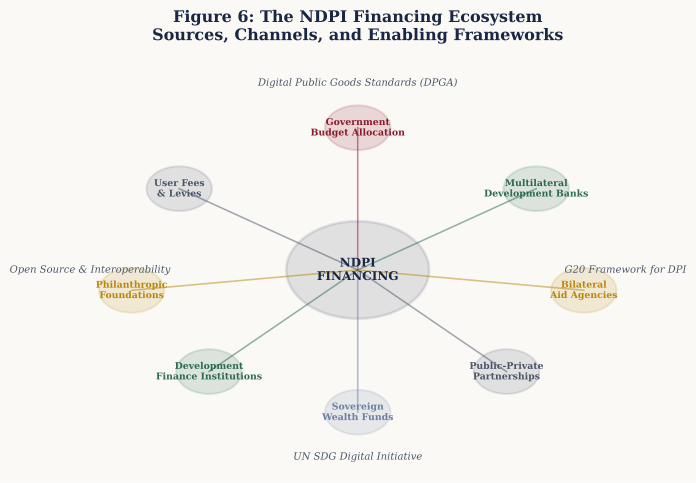
Figure 6: Conceptual framework of the NDPI financing ecosystem. Eight funding channels feed into the central financing pool, while four enabling frameworks — the Digital Public Goods Alliance (DPGA) standards, the G20 DPI Framework, the UN SDG Digital initiative, and open-source interoperability norms — shape the architecture of what gets built.
Two trends deserve particular attention. First, the G20 DPI Framework, endorsed at the 2023 New Delhi Summit, is emerging as a soft governance standard that shapes MDB lending conditionality and bilateral aid priorities. Second, the Digital Public Goods Alliance (DPGA) registry is increasingly used by donors and procurement officials to identify open-source DPI components — creating a de facto certification that influences financing flows.
9. Policy Recommendations
Based on the comparative analysis above, we offer the following recommendations for governments, development finance institutions, and philanthropic funders:
For National Governments
1. Establish a dedicated NDPI budget line — not buried in general IT expenditure — with multi-year visibility to enable long-term procurement and capacity building.
2. Prioritise digital ID and payments as the foundational layers; data exchange and cloud services can follow incrementally.
3. Require open-source licensing for publicly funded DPI components as a default condition of procurement, following Estonia's X-Road precedent.
4. Establish independent data protection authorities before large-scale biometric enrolment — not after the infrastructure is built.
For Multilateral Development Banks
5. Increase the share of DPI-specific lending within digital sector portfolios from the current ~40% toward 60%, with emphasis on the underfunded data exchange and cloud layers.
6. Develop standardised DPI cost-benefit frameworks — the absence of consistent ROI data is a barrier to political commitment in finance ministries.
7. For IDA-eligible countries at high risk of debt distress, shift from loan to grant financing for DPI — the public-good character justifies concessionality.
For Philanthropic & Bilateral Funders
8. Focus catalytic funding on open-source DPI components (MOSIP, X-Road, OpenG2P) and interoperability standards — areas where modest grants can shape an entire ecosystem.
9. Fund independent civil-society monitoring of DPI privacy and exclusion impacts — accountability infrastructure is as essential as technical infrastructure.
10. Support South-South knowledge transfer: India's NPCI and Estonia's NIIS have expertise that lower-income countries need — fund the institutional bridges.
10. Conclusion: Building for the Long Run
National Digital Public Infrastructure is not a one-time capital project. It is an ongoing institutional commitment — closer to a public health system than a bridge. The financing models that work are those that recognise this temporal dimension: multi-year sovereign budget allocations, sustained MDB engagement, lean open-source governance for data exchange layers, and catalytic philanthropic support for the components that markets will not fund.
The countries that have built NDPI most successfully — India, Estonia, Brazil, Ukraine — have done so not by spending the most, but by spending intelligently: layering identity, payments, and data exchange in a logical sequence, maintaining public-sector architectural control while enabling private-sector innovation atop public rails, and embedding privacy and accountability mechanisms from the start.
For the 100+ countries that have committed to DPI as an SDG accelerator but have yet to build it, the financing path is clearer than it was a decade ago. The models exist. The cost-benefit case is strong. The remaining challenge is political will — and the design of financing architectures that preserve the "public" in digital public infrastructure.
Data Sources & Further Reading
- G20 New Delhi Leaders' Declaration (2023). Framework for Systems of Digital Public Infrastructure.
- United Nations (2023). Our Common Agenda Policy Brief 5: A Global Digital Compact.
- World Bank (2024). Digital Public Infrastructure: Transforming Service Delivery Across Sectors. Washington, DC.
- UIDAI (2024). Aadhaar Dashboard. Unique Identification Authority of India, uidai.gov.in.
- NPCI (2025). UPI Product Statistics. National Payments Corporation of India, npci.org.in.
- Nordic Institute for Interoperability Solutions (NIIS). X-Road Data Exchange Layer. niis.org.
- Kivimäki, P. (2018). "There Is No Blockchain Technology in the X-Road." NIIS Blog, 26 April 2018.
- Eaves, D. & Rao, K. (2025). "Digital Public Infrastructure: A Framework for Conceptualisation and Measurement." UCL IIPP Working Paper 2025-01.
- Khera, R. (2018). "Aadhaar, India's ID System, Is a Cautionary Tale." The Washington Post, 9 August 2018.
- Bandura, R., McLean, M., & Sultan, S. (2023). "Unpacking the Concept of Digital Public Infrastructure." Center for Strategic & International Studies (CSIS).
- OECD (2024). Digital Public Infrastructure for Digital Governments. OECD Digital Government Studies, Paris.
- Zuboff, S. (2019). The Age of Surveillance Capitalism. New York: PublicAffairs.
- Ostrom, E. (1990). Governing the Commons. Cambridge: Cambridge University Press.
- Human Rights Watch (2018). "India: Identification Project Threatens Rights." hrw.org, 13 January 2018.
- Financial Times (2023). "The India Stack: Opening the Digital Marketplace to the Masses." 20 April 2023.
- Zuckerman, E. (2023). "The Case for Digital Public Infrastructure." Knight First Amendment Institute, Columbia University.
- Digital Public Goods Alliance. DPGA Registry. digitalpublicgoods.net.
- German Sovereign Tech Fund. Investing in Open Digital Infrastructure. sovereigntechfund.de.
- Krewer, J. (2024). "Signs of Progress: Digital Public Infrastructure Is Gaining Traction." Open Future, 13 March 2024.
- Ministry of Digital Transformation of Ukraine. Diia: Digital State. diia.gov.ua.
Citation: Hughes, H. (2026). Financing National Digital Public Infrastructure — How Governments Fund Digital ID, Payments, Data Exchange, and Cloud Infrastructure as Public Goods. H Heuristics Research Report, August 2026. Published at hheuristics.com.